H. Klüver, DG7YBN, core AGTC by J.-P. Waymel, F5FOD; Build 2026-08-14
K
K
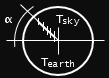
Tsky represents the radio noise from the sky:
Galactic/cosmic noise and atmospheric noise.
See note 1.
The user may set any value between 0 and 9999999 K.
In the VE7BQH Antenna Tables Tsky[2,3] is taken by default as a first approximation:
Galactic/cosmic noise and atmospheric noise.
See note 1.
The user may set any value between 0 and 9999999 K.
In the VE7BQH Antenna Tables Tsky[2,3] is taken by default as a first approximation:
| Use | 50 MHz | 144 MHz | 432 MHz |
|---|---|---|---|
| By Default | 5640 K | 290 K | 27 K |
Tearth represents the radio noise originating from the Earth's surface. It may include man made noise (when unavoidable).
Radio noise varies with location and time. See note 1. The user may set any value between 0 and 9999999 K.
In the VE7BQH Antenna Tables Tearth[2,4] is taken by default:
Radio noise varies with location and time. See note 1. The user may set any value between 0 and 9999999 K.
In the VE7BQH Antenna Tables Tearth[2,4] is taken by default:
| Environment | 50 MHz | 144 MHz | 432 MHz |
|---|---|---|---|
| Rural | 29700 K | 1600 K | 760 K |
| Residential | 100600 K | 5400 K | 1800 K |
| City | 270800 K | 14550 K | 8200 K |
• Load Antenna Far Field Table files: Create complient FFTabs
| Antenna 1: | No FFTab file selected | |
| Antenna 2: | No FFTab file selected |
Compute G/T with antenna 1, compare to G/T with antenna 2 or apply Correction of Convergence Errors to an antenna.
Instructions for the Correction of Convergence Errors
For Antenna 1, load FFTab created from NEC model with losses,
for Antenna 2, load FFTab created from this NEC model with no loss.
for Antenna 2, load FFTab created from this NEC model with no loss.
• Set Receiver Chain Parameters:
|
dB
dB
dB
dB
dB
|
|
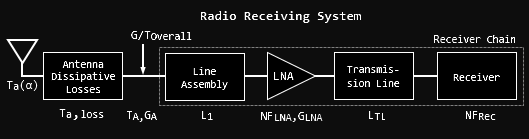
*) Total Loss of components in line between Antenna Terminal and input connector of the LNA.
It is assumed, that the system is linear, its blocks are 'matched'
and the physical temperature is 290 K (16.85°C or 62.33°F) throughout. Radio noise is white Gaussian noise.
Note 1: Radio noise varies with location and time.
Values given in the tables above function as a first approximation for individual analysis.
For further read see: Recommendation ITU-R SM.1753-2, Methods for measurements of radio noise, 7.2 Antennas.
The AGTC core in any version calculates using uniform Tsky and Tearth for the full sight of sky sphere respectively earth sphere up to the horizon,
Antenna Temperature is calculated at 30 degrees of elevation, all according to the DJ9BV model[1].
References
1. Fundamental for the making of the AGTC core and emphasising alpha = 30 deg.
is DJ9BV's well known article:
• Bertelsmeier, R., DJ9BV: Effective Noise Temperature of 4-Yagi-Arrays for 432 MHz EME, Dubus 4/1987
• F5FOD with DG7YBN: Antenna G/T Calculators with Open Source Code, Part 1-4, Dubus 1-4/2017
2. Edwards, L. H., VE7BQH: Issue of VE7BQH Antenna Tables as Interactive Mode making use of external noise temperatures derived from
the ITU-R P.372-13 as suggested values, developed, initated and implemented by UR5EAZ, 2017-06-10. See also 'A G/T Story'; Moon Net, Message #26606, 2017-12-15.
3. Tsky:
• 50 MHz: Tsky: is produced from the ITU recommendations P.372-13
• 144, 432 MHz: DG7YBN: Update to Sky and Earth Temperatures for VHF/UHF Amateur Radio Bands, Dubus 2/2019
4. Tearth:
• 50 MHz: Tearth: Estimated Values for man-made noise (Tearth) on 50.150 MHz acc. ITU-R P.372-13: Part 6, Man-made Noise, p. 98-100
• 144, 432 MHz: Tearth acc. Man-Made Noise in Our Living Environments; U.R.S.I. Radio Science Bulletins No. 334, 09.2010.
5. The general practice for calculating Ta, TA is contained in:
• Mumford, W. W., Scheibe, E. H.: Noise Performance in Communication Systems,
Horizon House – Microwave, Inc., 1968; Eq. (13), (22), (23), Chap. 5
6. Basic formula for TOverall:
Otoshi (A-4), modified to 3 Two-Ports plus added receiver,
referred to the input of the 1st transmission line i. e. ’Losses Ant. > LNA (1)’.
• Otoshi, T. Y.: Calculation of Antenna System Noise Temperatures at Different Ports—Revisited, IPN Progress Report 42-150, 8/2002
7. Vladimir UR5EAZ, "Effective Noise Temperature & G/T Calculator", MS Excel, NF_GT_DELTA_SNR_V1.xls file,
Moon Net, Message #38631, 2021-09-21;
Quote: ’The G/T ratio is proportional to S/N; Change in G/T is equal to change in S/N (ΔG/T = ΔS/N)’.
8. Kharchenko, V. V., Program RFNC, V 1.1, 2025-12-06; dg7ybn.de/Ant_soft/Ant_Software.htm#RFNC
Quote: ’The signal to noise ratio SNR (S/N) is proportional to M (G/T)’.
9. Edwards, L. H., VE7BQH: Issue of VE7BQH Antenna Tables, Figure of Merit G/T or S/N, developed, initated and implemented by UR5EAZ, 2023-11-15
10. Cake, B. V., KF2YN: The Correction of Convergence Errors in Antenna Temperature Calculations, Dubus 4/2010
Acknowledgments
I would like to thank Xu Da, BG5TOX for introducing the very first web utility AGTC built as a one page html and JavaScript,
further Jean-Pierre Waymel, F5FOD for porting the full AGTC including all test routines to html with JavaScript.
Core and appearance of AGTC Twain build on the works of BG5TOX and F5FOD.
I would like to thank Vladimir Kharchenko, UR5EAZ for precise feedback, useful comments, suggestions and persistance in teaching me.
Any errors or shortcomings are entirely my own.
This program web page has been visited how often since June 2026?