
-
• Main Page
- • Home
• Antennas - • 10.1 MHz
- • 14 MHz
- • 18 MHz
- • 24.9 MHz
- • 28 MHz
- YBN 28-4wA 4.0 m long 28 MHz 4 ele. straight split Dipole to be very uncritical for home building.
Elevation Plot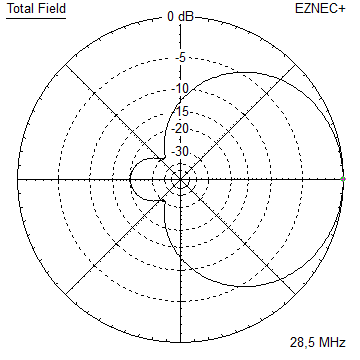
- YBN 28-5wA 7.6 m long 28 MHz 5 ele. straight split Dipole to be very uncritical for home building. A wideband version with hugh bandwidth and yet high F/B.
Elevation Plot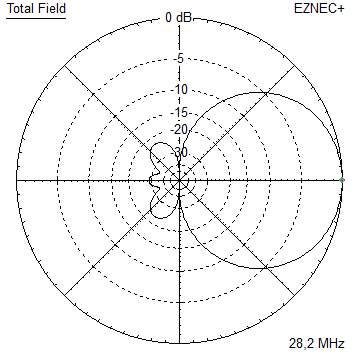
- YBN 28-5LA 8.3 m long 28 MHz 5 ele. straight split Dipole to be very uncritical for home building.
Elevation Plot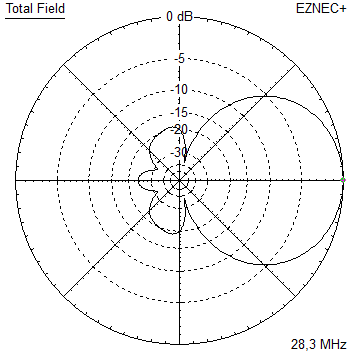
- YBN 28-6nA 9.6 m long 28 MHz 6 ele. straight split Dipole to be very uncritical for home building.
Elevation Plot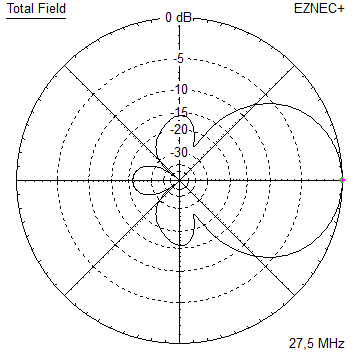
- YBN 28-7mA 13.9 m long 28 MHz 7 ele. straight split Dipole to be very uncritical for home building.
Elevation Plot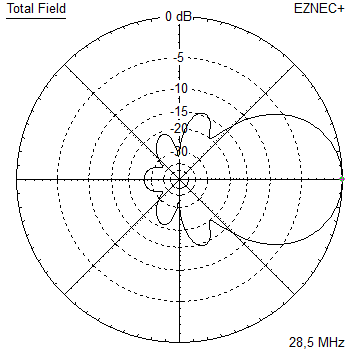
- YBN 28-7wA 13.6 m long 28 MHz 7 ele. straight split Dipole to be very uncritical for home building.
Elevation Plot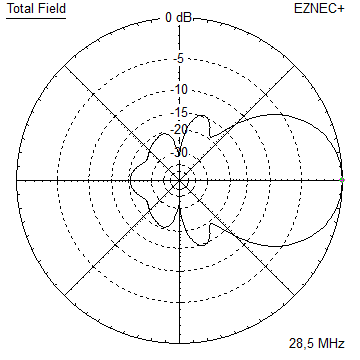
- YBN 28-8mA 17.2 m long 28 MHz 8 ele. straight split Dipole
Elevation Plot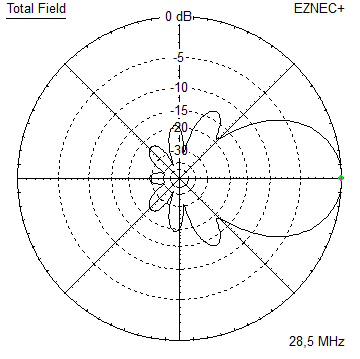
- GTV 28-4wA 5.2 m long 28 MHz 4 ele. with bent Dipole.
Elevation Plot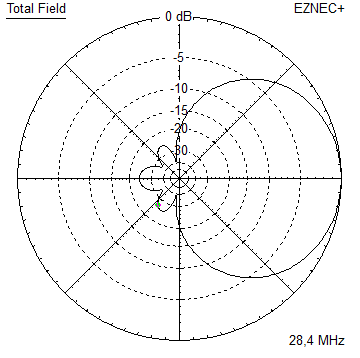
- GTV 28-5mA 8.2 m long 28 MHz 5 ele. with bent Dipole.
Elevation Plot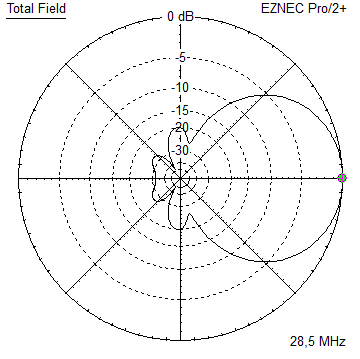
- GTV 28-7wA 13.7 m long 28 MHz 7 ele. with bent Dipole.
Elevation Plot
- GTV 28-9wA 20 m long 28 MHz 9 ele. with bent Dipole.
Elevation Plot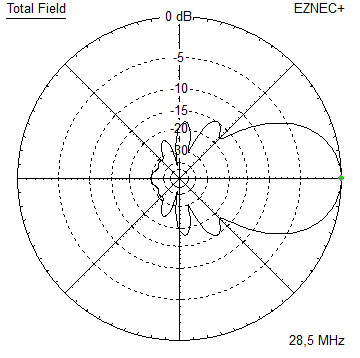
- GTV 28-9m LTA 23 m long 28 MHz 9 ele. with bent Dipole.
Elevation Plot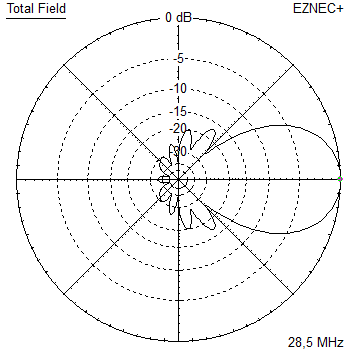
- YBN 28-4w
- • 50 MHz
- • 70 MHz
 Performance Data and Geometry Pattern and VSWR With Ground Gain Stacking
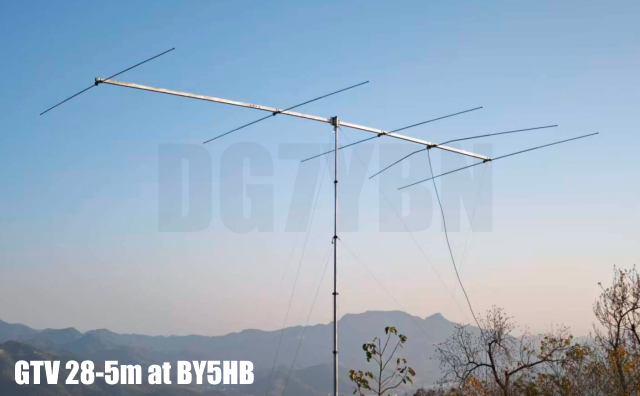
GTV 28-5m with bent Dipole
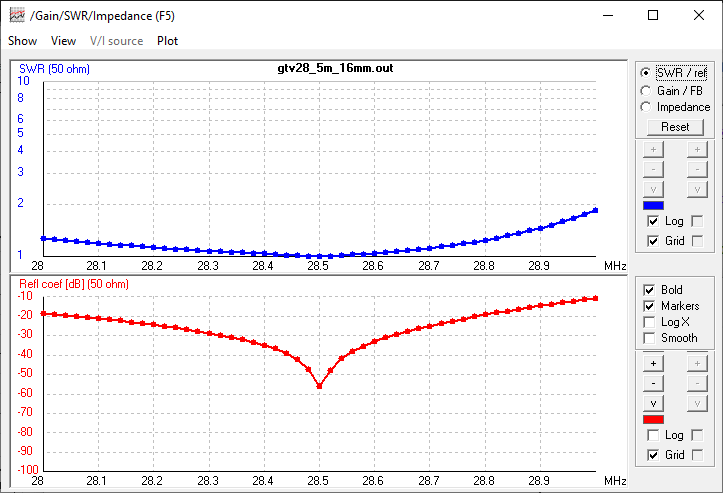
28.1 to 28.7 MHz with VSWR < 1:1.2 (Return Loss better -20 dB)
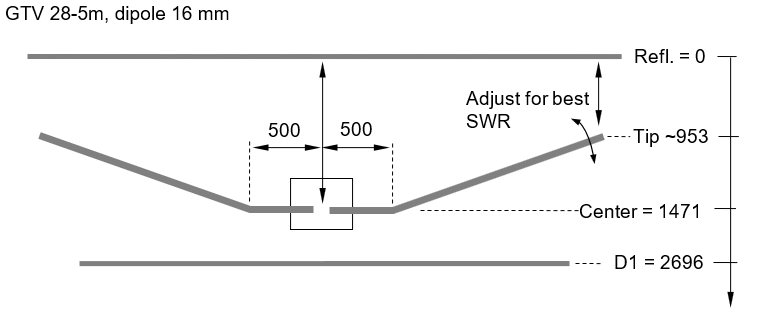
On 28 MHz we should less look for gain but for a very clean pattern, because if the band is open, successful DX more or less comes down to fade out unwanted signals. If we can easily produce a signal that enables us to ping our own echo when twice (!) around the globe with less than 100 watts of output, we may pass on 0.5 dB of gain. And when band is closed that little bit would not help at all. The bent dipole (K6STI style) transforms to 50 ohms at feed point for direct feed.
Design date of issue: 2025.12.07
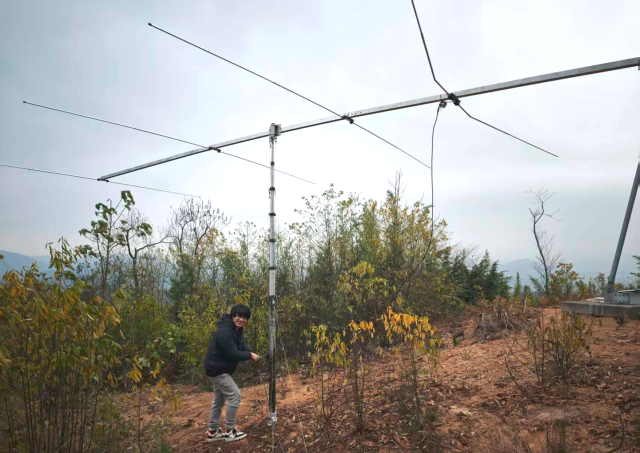
This Yagi built by BG5TOX at all - BY5HB, Xiaoshan Radio Amateur Club
during 2025 ARRL 10 m contest (claimed score 477,996 points).
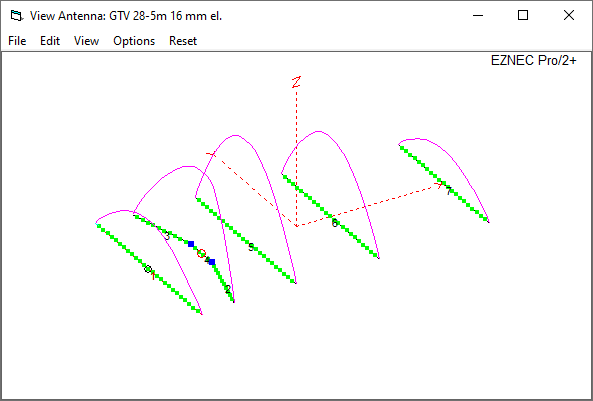
Current distribution
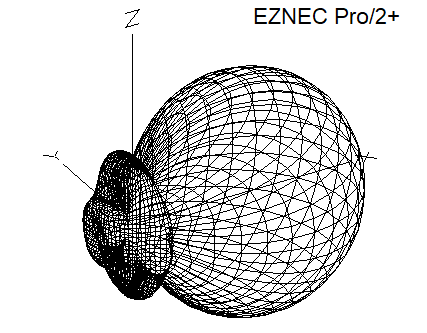
Performance Data (28.5 MHz, 16 mm el.)
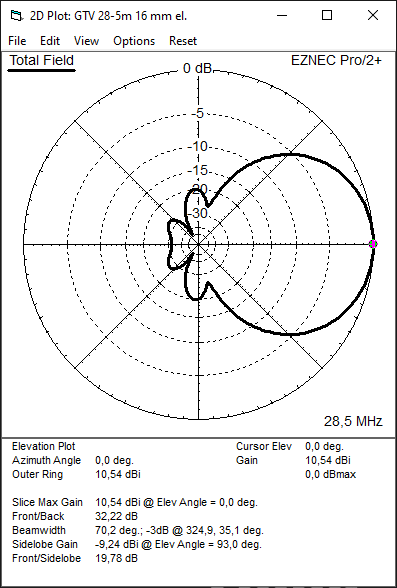
Gain vs. isotr. Rad.  10.5 dBi
Gain vs. Dipole        8.4 dBD
-3 dB E-plane         52.6 deg.
-3 dB H-plane         70.2 deg.
F/B                  -32.2 dB
F/R                  -19.8 dB
Impedance               50 ohms
Mechan. Length        8202 mm + 2 x 50 mm offset
Electr. Length        0.78 λ

Stacking Distance
top-to-bottom (vert.)  9.1 m
Geometry
On Request ...
How many pageviews did this design get since Dec. 2025?

Pattern and VSWR Plots, free space simulation
Elevation and Azimuth plot at 28.5 MHz
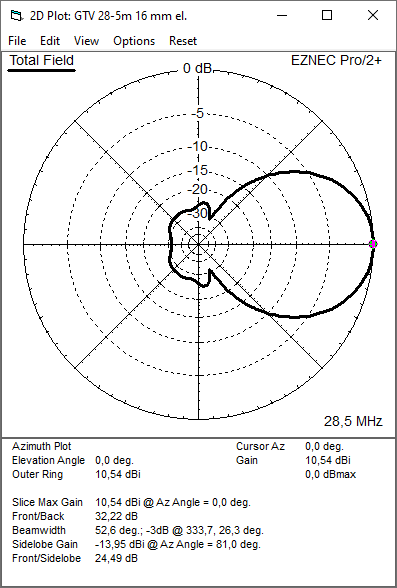
SWR and Return Loss plots - simulated with 4nec2
Sketch of Bent Dipole
Radiation pattern with Ground Gain (28.5 MHz)
• At 12 m above perfect ground
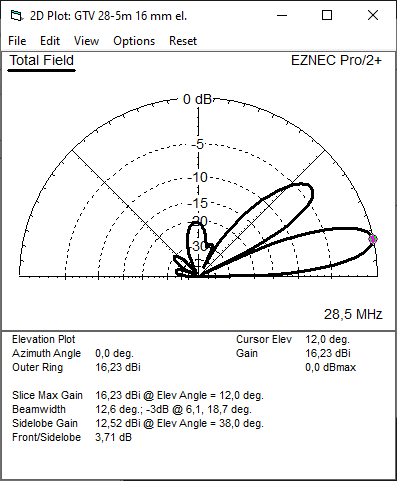
Gain vs. isotr. Rad.  16.2 dBi  at  12 deg.
Gain vs. Dipole       14.1 dBD
F/B                  -30.2 dB   at 140 deg.
• At 16 m above perfect ground
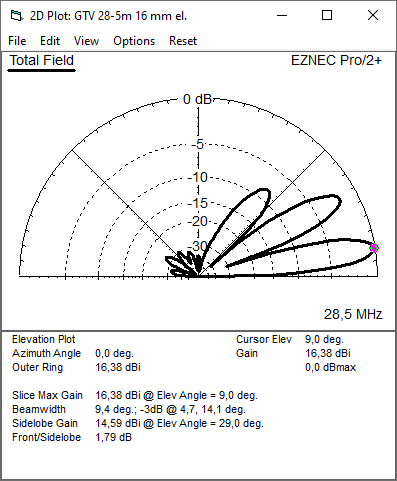
Gain vs. isotr. Rad.  16.4 dBi  at   9 deg.
Gain vs. Dipole       14.2 dBD
F/B                  -27.0 dB   at 149 deg.
Stacking
• 2 x vertical GTV 28-5m, lower Yagi 12m agl, upper + 9.1 m:
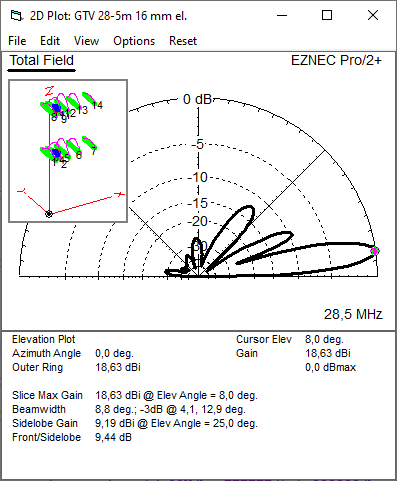
Gain vs. isotr. Rad.  18.6 dBi  at   8 deg.
Gain vs. Dipole       16.5 dBD
F/B                  -29.0 dB   at 172 deg.
73, Hartmut, DG7YBN